“Since Bandcamp accounts have been upgraded to Enhanced Payments today, June 20, 2023. From this date onwards, payments for physical merchandise will be processed in the same way as digital sales.
One feature of Enhanced Payments is that Bandcamp will now collect and remit certain import taxes on your behalf. Some countries have implemented an ID system so their customs agents can verify that these taxes were collected properly.”
For those reasons, if you are interested with buying any An’archives title(s), we’d recommend to order directly from us to avoid those new fees which can be very high. Also, if you need a DL code, you can ask us when ordering and we could provide you one for free. We just consider that this site is not viable anymore for physical orders.
Please don’ t be lazy, you can email us, it only takes a few more minutes than clicking on a few buttons.
Thanks for reading and very sorry for those sad news
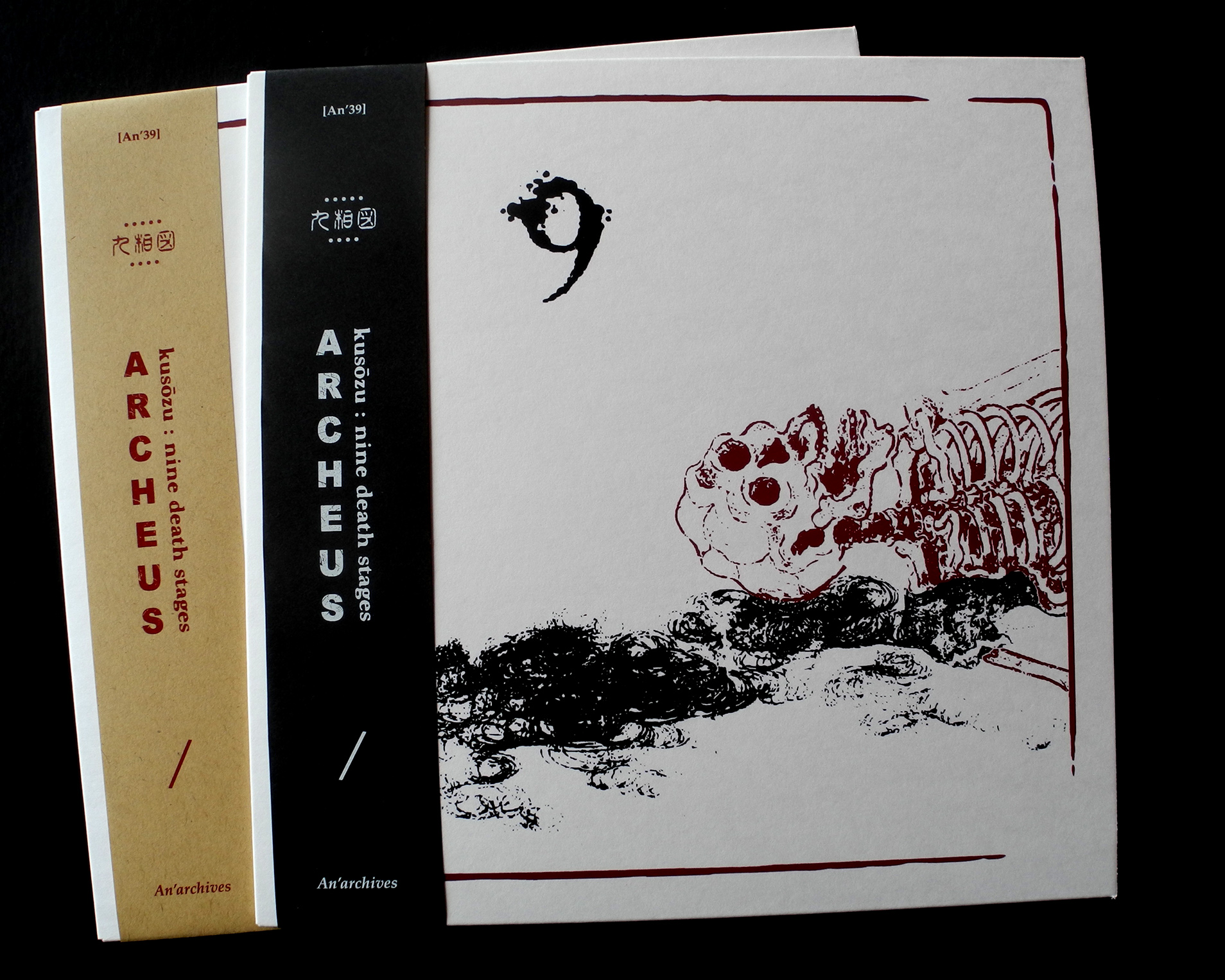
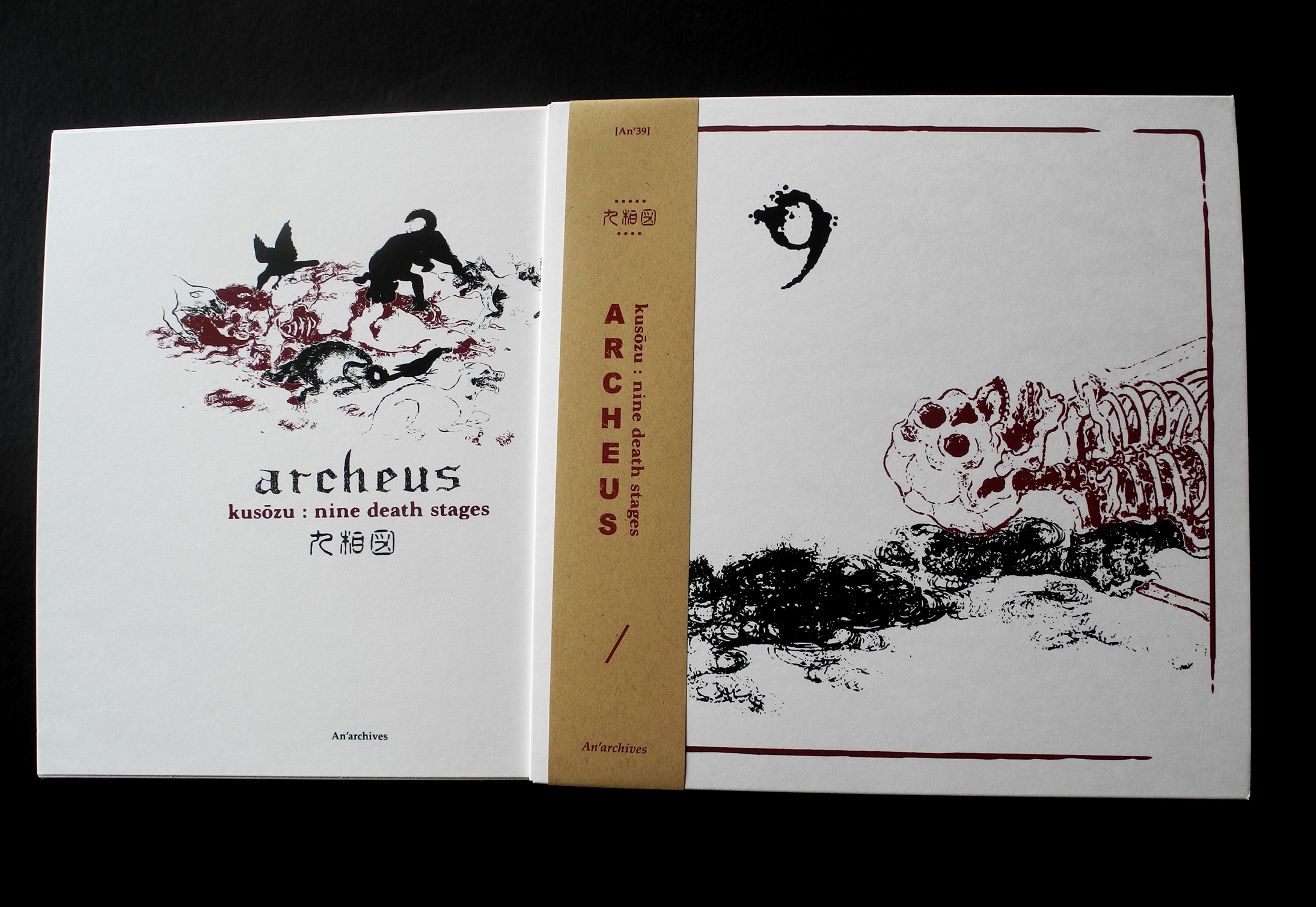
12″LP black vinyl, comes in a 2 colors silkscreened heavy jacket with obi (black or kraft), inserts and a postcard by Vincent Guilbert. Edition of 350
Printed by Alan Sherry & liner notes by Jon Dale
Kusōzu : Nine Death Stages is the second album by the Tokyo trio Archeus, which consists of Keiko Higuchi (voice, percussion, trombone, shamisen), Shizuo Uchida (bass strings), and TOMO (hurdy gurdy, voice). It follows their debut, self-titled and self-released CD and cassette from 2021 and is further proof – if any were needed – that these musicians, who’ve known each other for some time, but only started playing together relatively recently, share a telepathic communication, improvising together, fully in the moment, and as one. Where their debut album featured four extended improvisations, Kusōzu is an object lesson in economy and clarity – nine tracks, thirty-three minutes, everything that needs be said and nothing more.
All three musicians are incredibly active in the Japanese underground. Higuchi currently plays with Sachiko in Albedo Fantastica, adding Uchida for Albedo Gravitas; Uchida and Higuchi team up with Masami Kawaguchi (guitar) in vDBG. She’s also recorded with improvisers such as Naoto Yamagishi, Yasumune Morishige, and Shin-Ichiro Kanda. Uchida is also a member of MAI MAO, Kito-Mizukumi Rouber, Hasegawa-Shizuo, UH, and TERROR SHIT, and he’s recently recorded with improvising guitarist Takashi Masubuchi; TOMO has previously been a member of Tetragrammaton and Pouring High Water, and has recently performed live with Mick of Kousokuya, Mitsuru Tabata, Keiji Haino, and Daisuke Takaoka.
While Higuchi and Uchida have been making music together for some time now, they appear careful not to impose their previously articulated lexicon to bear on Archeus. There are trace elements of their playerly voices still present – the stretchy, plastic scrabbling on bass strings from Uchida; Higuchi’s murmurations of tone, and sudden plunges back down to earth, vertiginous and woozy – but there are other things going on here, particularly with TOMO joining in the action. His hurdy gurdy is a wild card in a group of wild cards, here cranking out burred, purring drones, there fidgeting through floods of notes, cranked up really high, ducking and weaving between Higuchi and Uchida as the three pursue the eternal now that is core to the best improvised music.
Archeus seem to work alchemically, transmuting their base matter into gold. Named after the Buddhist art practice of kusōzu, the graphic painting of nine stages of a decaying corpse in the open air, “to demonstrate the effects of impermanence,” as scholar Gail Chin once wrote,
Kusōzu : Nine Death Stages is Archeus at their most rigorously attentive to each other’s playing, and by the end, the music is itself thinking and feeling.
Jean Noël Rebilly & Andrew Chalk CD Tsilla – An’archives
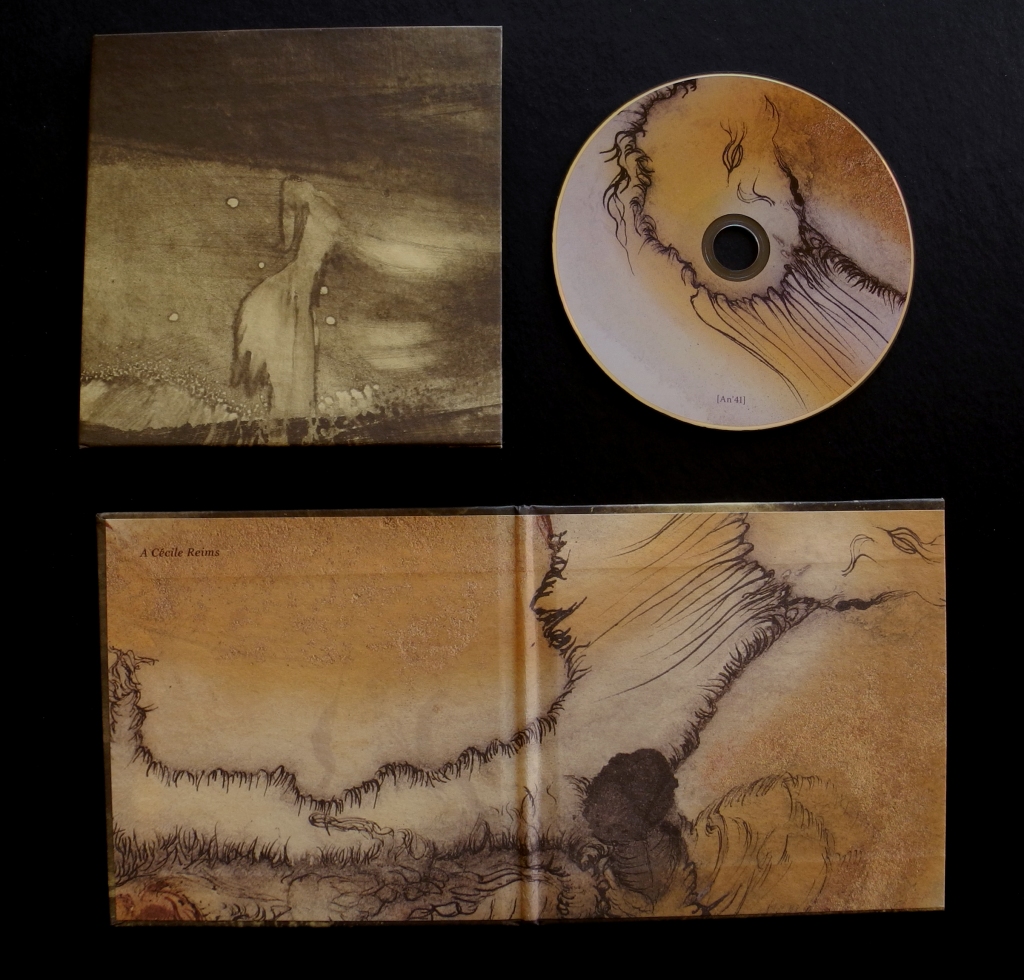
Edition of 300, comes in a mini handmade gatefold jacket
Catalogue number : [An’41]
Mastered by Denis Blackham
“On Tsilla, Jean-Noël Rebilly and Andrew Chalk pay homage to the late French writer and engraver Cécile Reims. While she may be best known as interpretative engraver for surrealist artist Hans Bellmer, and she also worked with Leonor Fini and briefly for Salvador Dali, Reims’ most powerful and enduring works were made either in collaboration with her husband, the writer and artist Fred Deux (who signed their collaborative work “cf deux”), or by herself. Later works by Reims, like the L’Elan Vitale suite, or the Histoires Naturelles series, manifest denuded, obliterated landscapes; spiralling abstractions; engravings that shiver with an unearthly radiance, where etchings of great intricacy hint at intimacy and the velocity of rapture, before opening out to aching empty spaces. The music on Tsilla is similarly evocative, a tender weaving of emotional complexity carved with the hand-held and simple tools of artisans. Much like Reims, Rebilly and Chalk enact a similar transfiguration of base materials. For Reims, natural order is made “more sinuous and curious through the rounded flow of her graver,” Kate McCrickard once noted. For Rebilly and Chalk, these seven pieces, cast under the shadow of a great artist, inhabit that sinuousness, and tease out the eternal flow of tone.”
Distribution / wholesale : France : Soufle Continu shop & label : contact@soufflecontinu.com
and available from ;
UK : This Ain’t Distribution / Japan Blues / ICR Distribution
15€
In a same time we have these 2 for distribution and you can save with postage….
Francis Plagne & Andrew Chalk
CD The Painter’s Family
Label : Mould Museum
Catalogue number : MM 03
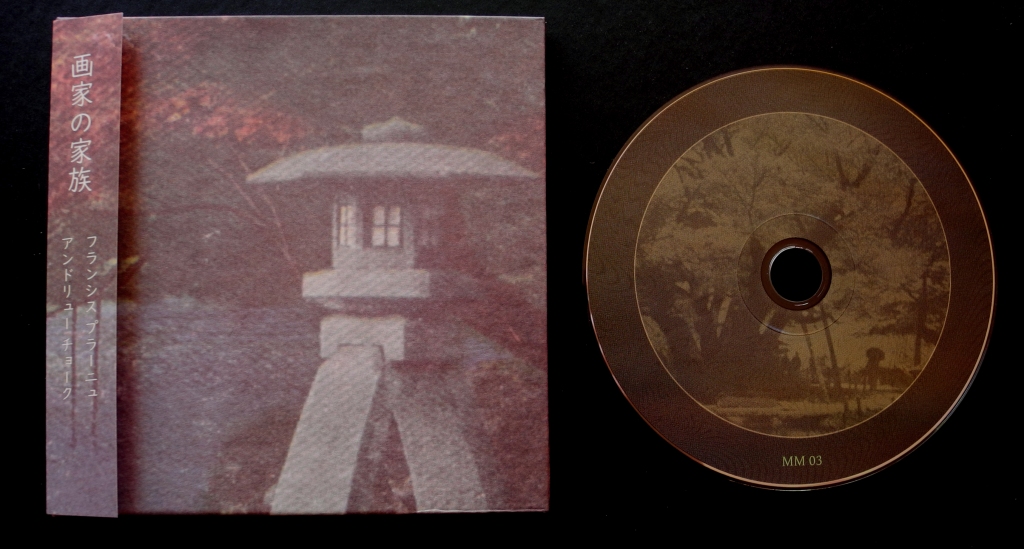
Edition of 300, comes in a mini handmade gatefold jacket with obi
Recorded 2008-2016, released on cassette in 2018.
Recorded 2008-2016 and originally released on cassette in 2018.
The Painter’s Family is the first duo release from Andrew Chalk and Francis Plagne, recorded intermittently, both together and apart, over eight years, in Hull, Melbourne and various places in Japan. Eight pages from the sketchbook, sequenced into two languorous side-long suites.
Mastered by Joe Talia.
“He tried by every means to come close to nature, lying in the fields before daybreak and until nightfall in order to learn to represent very exactly the red morning sky of sunrise, sunset and the evening hours”
Edition of 300, comes in a mini handmade gatefold jacket
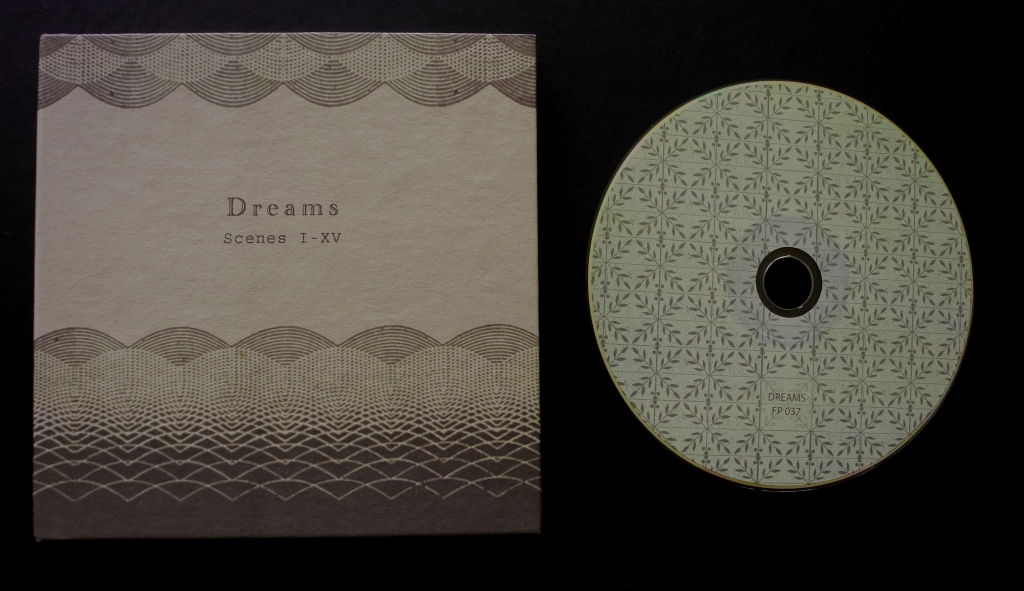
Dreams, subtitled Scenes I-XV, captures imaginary scenes and sequenced into a full album of 52 minutes length at Impression Lointaine.
Dreams being archaic and unpredictable in its composition, such as dreams themselves that make little sense upon waking and assembled using time limited constraints.
And while immersed, and in privacy, form a thread of personal communication like a nostalgic memory-a painting of which we inhabit ourselves.
12″LP black vinyl, comes in a 2 colors silkscreened jacket with obi (black, red, green tea), inserts and a postcard. Edition of 285
Printed by Alan Sherry & liner notes by Jon Dale
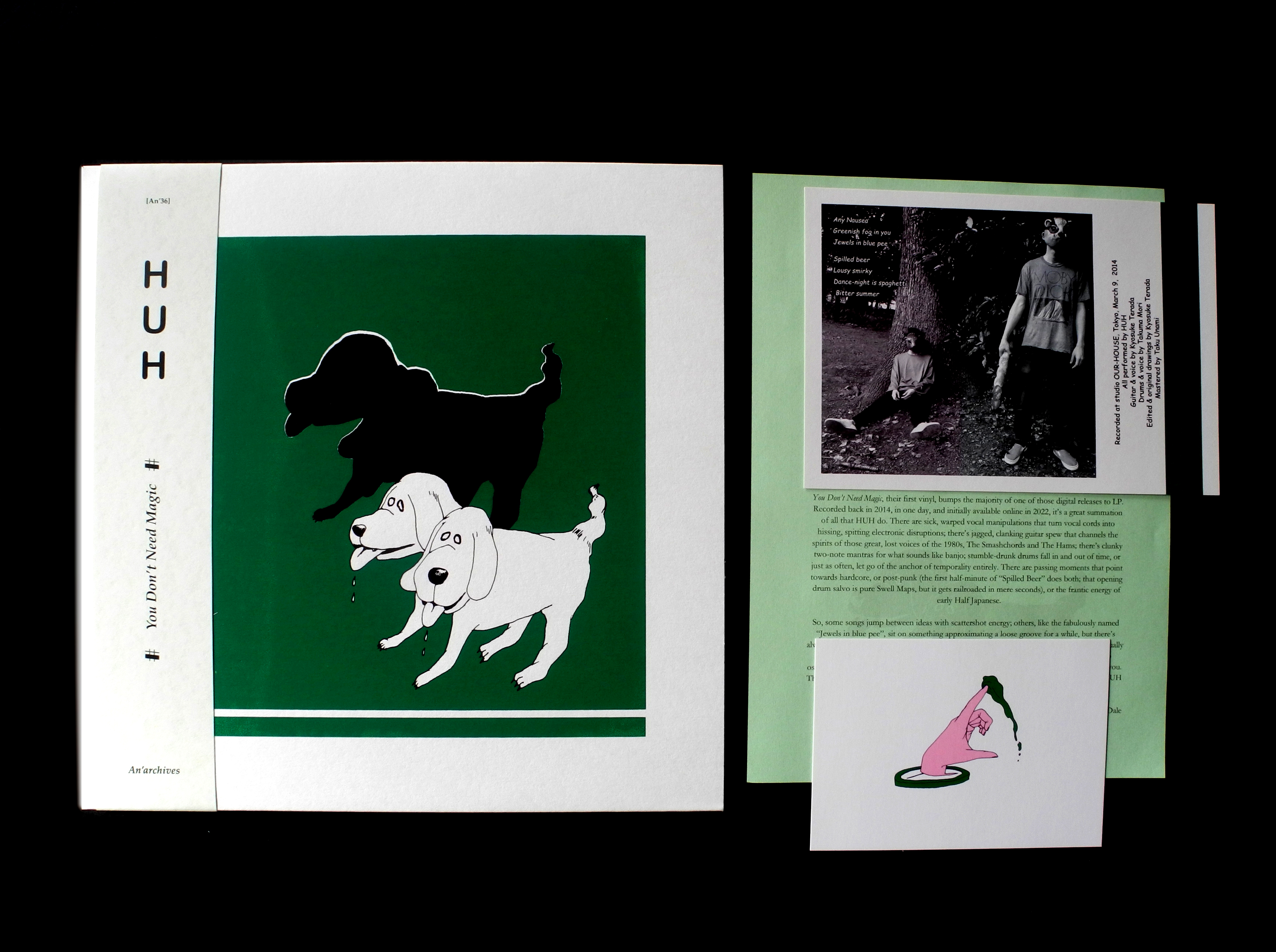
HUH are the wild, freeform duo of Kyosuke Terada and Takuma Mori. Based in Tokyo, and playing together since 2007, HUH have released a clutch of cassettes, CD-Rs, and digital albums; they’ve toured Europe (in 2017) and Australia (2019); and they count amongst their collaborators the likes of T Mikawa of Incapacitants, ASTRO, and Government Alpha. You may know Terada from his duo with Shizuo Uchida, MAI MAO, who recently released an LP on An’archives, but he’s super prolific, performing solo and in groups like The Obey Unit, Bay City Rolaz, Praymate, Terror Shit, Death After Death, and more. Takuma Mori also records solo and is one half of duos Cosmetic i and Don’t Let Me Fantastic.
So, they’re busy, energetic musicians – but even that doesn’t quite explain the bustling energy and furious dislocation of the music they make together as HUH. It’s incredible, brain-blatting stuff, moving at a fierce clip between ideas, instruments, and styles – on a track like “Jewels in blue pee”, for example, a plunking banjo riff is repeatedly effaced by stumble-drunk drums, rumbling bass, and incongruous, high-wire blasts of electronics. There are voices in here, but they’re often mangled and distorted; rarely comprehensible, they melt into the unpredictable structures Terada and Mori build out of their junk kit.
HUH call themselves ‘free-form freak-out / noise improvisation’, and there’s a touch of the Familiar Ugly in the collective stammer and stutter central to their music. They’re remarkably untroubled by anyone’s expectations, resulting in a music that’s as confusing as it is compelling, full of clamour and vigour, but never for the sake of it: these seven improvisations, sometimes song-like, sometimes careening and hyperactive, sometimes smeared and abstract, all make their own kind of perfect un-sense. Line them up next to similarly puzzling yet enthralling gutterpunk improv units: Smegma, Bone Cure, Nihilist Spasm Band, Crayon Skidder.
12″LP black vinyl, comes in a silkscreened jacket with obi (black or ivory), inserts and a postcard. Edition of 400
Printed by Alan Sherry & liner notes by Jon Dale
Renoir Of The Toys is a deep dive into the world of Youri Kun, the nom de plume of Japanese guitarist, singer and songwriter Hiroshi Nar. It follows a similar compilation, Unheld Ball, released in 2022 on Japanese label Inundow; like that album, Renoir Of The Toys draws from the rich catalogue of outsider psych-garage and rock recorded by Youri Kun over the past two decades. Deeply wired into the history of Japanese underground music, Nar was a founding member of legendary ‘70s outfit Datetenryu, and a member of both Brain Police (Zuno Keisatsu) and Les Ralllizes Dénudés (Hadaka No Rallizes), appearing on the latter’s ’77 Live.
After going to ground during the 1980s, Nar started making music with Niplets in the mid-90s, and releasing music at a prolific pace in 2000 – an excellent run of (sometimes archival) CD-Rs on the Hello Goodbye Studio label, both solo, and with his groups Molls, Niplets and Port Cuss; an album on P.S.F. by Jokers, where he was joined by fellow Rallizes member Yokai Takahashi, and drummer Toshiaki Ishizuka (Brain Police, Vajra, Cinorama, etc.); and sixteen albums (and counting) as Youri Kun, for labels Gyunne Cassette, Inundow, and Hören. He’s also fallen in with the Acid Mothers Temple crowd, guesting on a few of their albums, and recording a live set with Kawabata Makoto’s Nishinihon trio.
All Nar’s music shares a deceptive primitivism; it moves with the simplicity of the best 1960s garage punk, but its edges are blurred and stretched, allowing for all kinds of weird, elliptical, and psychedelic moves to happen in its margins. His guitar playing on songs like “Kakunin” (from 2011’s Yamaimo Boogie) shimmies and slurs magnificently; “Kurokami”, from 2012’s Su, has clanking six strings scrawling over loose, spaced-out synth; there are clunky psychobilly moves (“Oshiro no Ninjya”), spirited rave-ups for rattling organ and sputtering guitar (“Totsugeki”), and some lovely, drowsy, melancholy moments (“Sora”). The constant throughout is Nar’s blues-blurred, drawling voice, as unique a tool as the non-idiomatic speak-sing styles of solo Syd Barrett, Jad Fair, or Dave E. McManus. There are also three Les Rallizes Dénudés covers here, where Nar locates the pop genius at the heart of songs like “Shiroi Yoru” and amplifies this with his simple garage-reverential take on things. Renoir Of The Toys is yet more evidence that Hiroshi Nar was, and is, one of Japan’s musical visionaries, a lonesome voice dedicated to a singular, streamlined vision, one that’s in eternal pursuit of the joy and kicks at the heart of rock’n’roll, and a reminder of what a great, unpretentious rock’n’roller truly
Regular edition comes in a silkscreened jacket with obi (dark blue & dark red), insert and a postcard. Edition of 550
Sub-edition of 150 exclusive to the label Silkscreened jacket, with black obi , insert and a postcard – subtle split fountain print making each cover slightly different alike a cyanotype…
exclusive 21 x 21 cm insert
Screenprinted by Alan Sherry
Following the long-awaited Paradise Of Delusion LP from 2021, An’archives announces Lunatic Pearl, a 10” EP by Japanese psych-pop legends Shizuka. As with the material on Paradise, Lunatic Pearl draws from the deep well of music the quartet recorded in 2001, this time from two studio sessions. Here, though, the group’s classic line-up of Shizuka, Maki Miura, Jun Kosugi and Seven is augmented – on the a-side, they’re joined by Yasushi Nagata on guitar; flip the record, and Kazuhide Yamaji chimes in on acoustic guitar and bass.
Both Nagata and Yamaji were members of long-running Tokyo psych-out gang Dip (also known as dip the flag); Yamaji eventually joined Shizuka for a time, appearing with them on the 2010 DVD, Owari No Nai Yume, released by PSF. Part of Lunatic Pearl finds Shizuka in Paisley Underground mode, the spaced-out acoustic mantras of “Shiroi Inochi” and the instrumental “The Street The Fairy Goes” surprisingly reminiscent of the smeared, slow-motion psychedelics of Opal’s early EPs. The latter, a weightless blur, hovers in the air on dreamy drifts of DX-7, drifting melodies landing on the track like an astral traveller, lost and delirious.
“Lunatic Pearl” itself is a monster, one of Shizuka’s most rock-reverent moments, its bold riff soaring over a rhythm section that thuds menacingly, as though they’re the kings of the rumbling spires. “Signs”, another track from the Studio EUN session, features some gloriously unhinged playing from Miura, as though he’s tearing the song’s seams apart, as the group push Shizuka’s simple, perfect song into the stratosphere.
Offset 7 ” jacket with screened obi (dark blue or dark red)
Edition of 500
Release & shipping date : Nov 25th
Paradise Of Delusion, the first vinyl release of the music of Japan’s legendary psych-pop group Shizuka, originally appeared in June 2021. Long-awaited, the LP sold out almost immediately, and already changes hands for three-figure amounts. An’archives is pleased to announce a CD edition of Paradise Of Delusion, making this music accessible again to a wider audience. Drawn from a 2001 performance at Binspark, Nishi Ogikubo, Paradise Of Delusion is gorgeous and otherworldly.
Shizuka first came to wider attention at roughly the same time as their peers in the Japanese underground – during the early nineties, when people started to get wise to the surprisingly wide-ranging post-psychedelic sounds from the PSF label. But even by the standards of their closest peers, aesthetically speaking –Fushitsusha (with whom they shared two members, Maki Miura and Jun Kosugi), Kousokuya, Chè-SHIZU – Shizuka were mysterious.
Led by the late Shizuka herself, a guitarist, vocalist, song writer, and doll maker, with her husband Miura, a devastatingly powerful guitar slinger, their songs were potent and seductive. Shizuka’s slow iterations of simple chord changes, with her psalmic vocal melodies over the top, suggest an existential exhaustion, often torn asunder by a soaring surge of guitar from Miura. Think the happy-sad mood of the Velvets’ third album, or a more languid Les Rallizes Denudes. Whatever is happening here is relentlessly private, psychologically introverted in many ways, but opened out to the possibilities of both beauty and despair – two states that the music of Shizuka best captures.
Silkscreened jacket & obi (textured tan or black) by Alan Sherry, inserts and a postcard –
liner notes by Jon Dale, ltd to 285
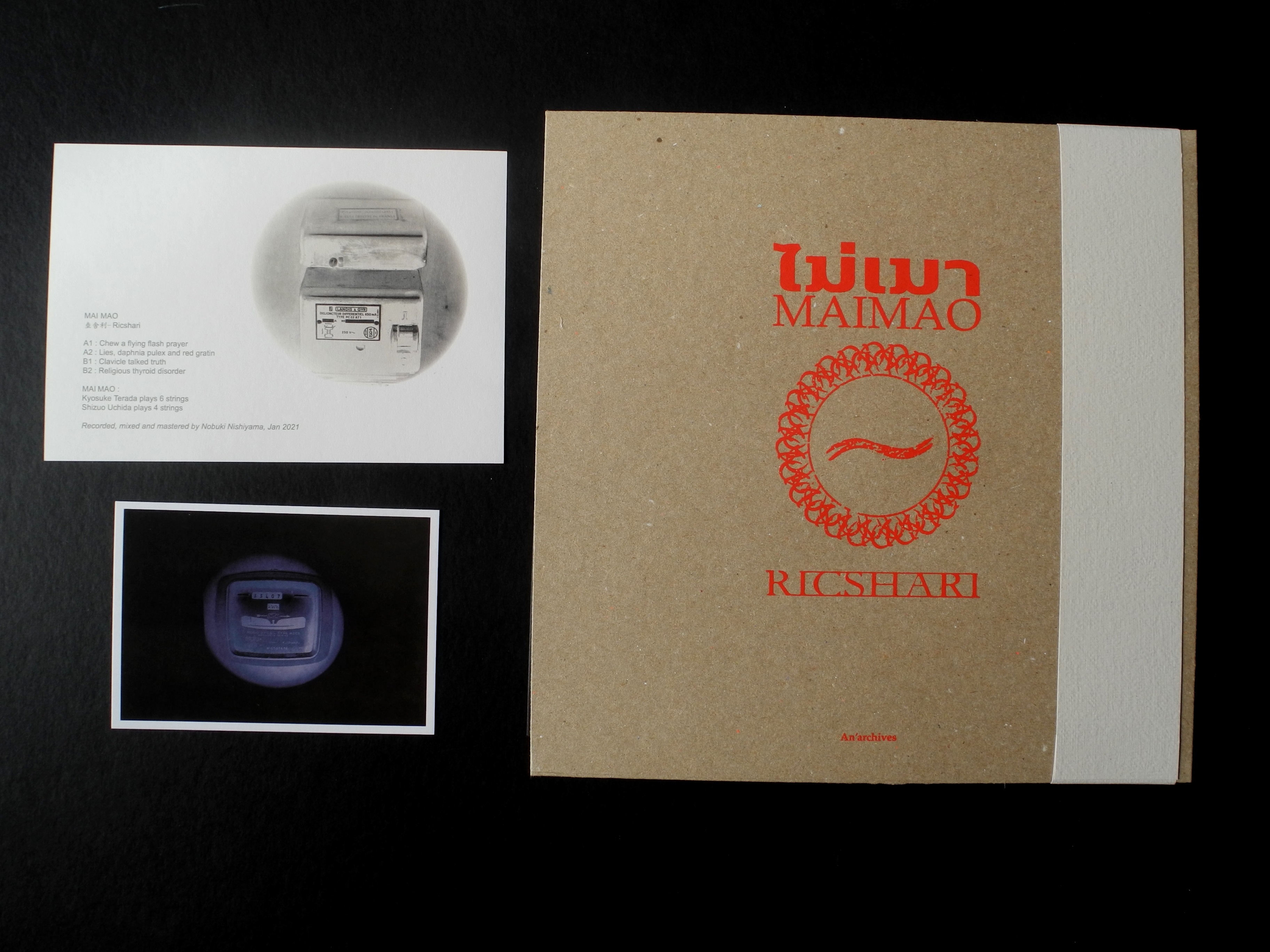
An’archives are thrilled to announce the release of Ricshari, the first LP from Japanese free improvising duo MAI MAO. Consisting of Shizuo Uchida of Hasegawa-Shizuo, Albedo Gravitas, archeus, Kito Muzukumi Rouber, TERROR SHIT, UH, etc. on bass, and Kyosuke Terada, of HUH (who have their own release due on An’archives soon), TERROR SHIT, Bay City Rolaz, Praymate, The Obey Unit, etc. on guitar, they’ve previously released two wild cassettes, Curvature Improvement Plan (Haang niap, 2020) and Folk Dope Rally (2021), both documenting one-take improvisations from live gigs. Ricshari was recorded by Nobuki Nishiyama in January 2021, and is proof, if any was needed, that this duo is one of the most fiercely unique, out-there units currently extant – in Japan, or anywhere, for that matter.
The music of MAI MAO seems to proceed by opposites and juxtaposition, shifting from frantic, hectic runs of splattering note spray to moments of granular stasis, where Uchida and Terada coax their instruments into and out of deep wells of silence, or rest, temporarily, in a lagoon of fermenting fuzz. Spiralling kinetics are largely the order of the day, though – the opener, “Chew a flying flash prayer”, skitters here and there, guitar and bass jumping over one another in games of leapfrog and Twister, finding new ways to perplex and puzzle the listener, and perhaps each other in the process, Uchida and Terada fully committed to the short-circuiting spirit of the moment.
The energy here is hyperactive, but it also speaks of a curious and committed attention to improvisatory responsiveness, one that’s just as likely to fork off into different directions in a split second – it’s real edge-of-the-seat stuff, as though the hands are moving too fast for the mind to follow. That’s all the better, then, to let the gush of genuinely free-thinking, devoted duo improvisation to fly at its most playful and intelligent. File next to the likes of Davey Williams & LaDonna Smith and their TransMuseq companions, or the wickedly perplexing bass-synth/trombone duets of Dave Dove Paul Duo, and you’ve some idea of what’s going on here, provisionally at least, ‘cos this one’s an enthralling, yet welcoming, head-scratcher of the highest calibre.
ltd to 385 copies -Silkscreened jacket with obi (tan, orange or black) & inserts, liner notes by Michel Henritzi
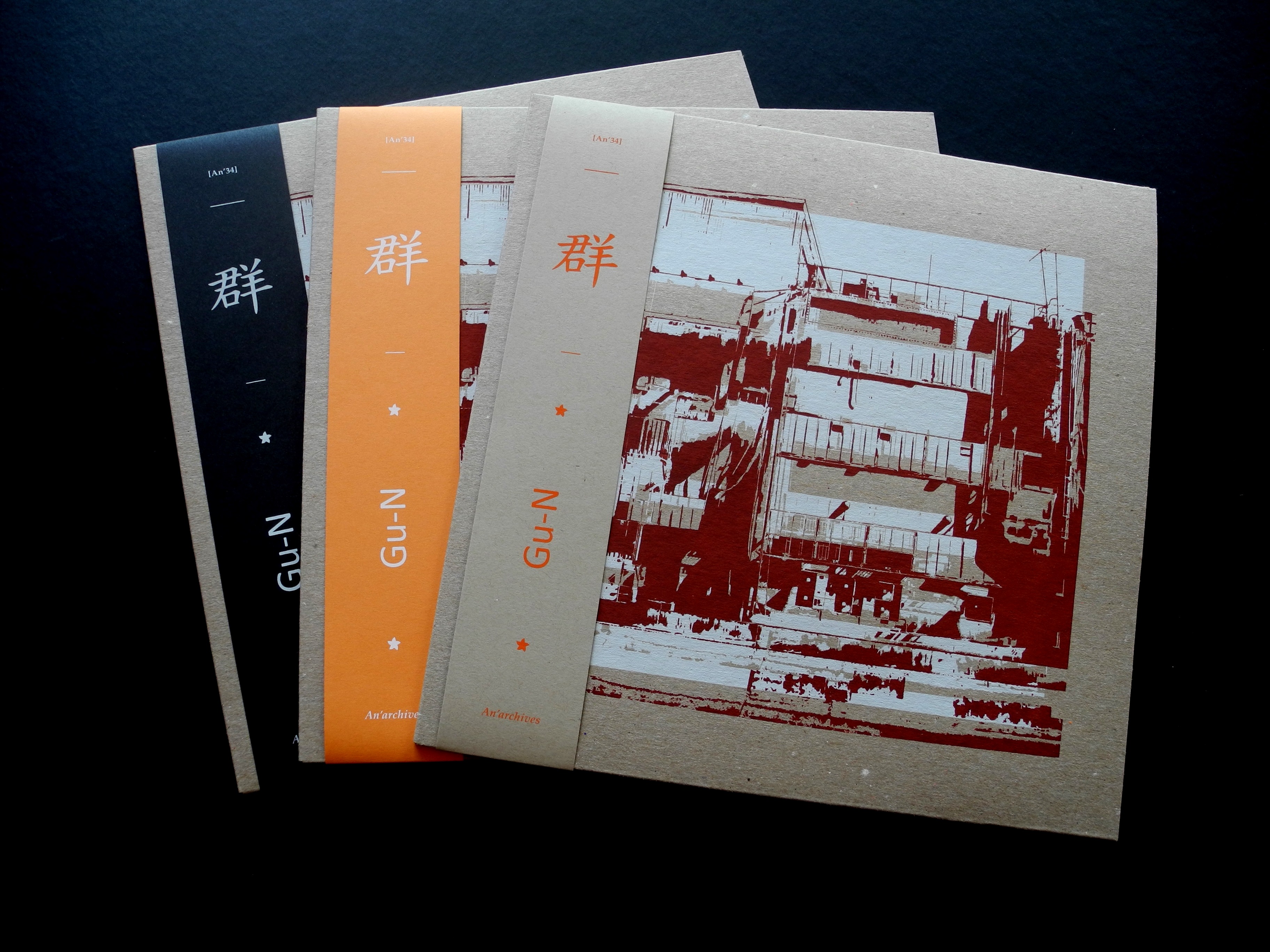
Formed in 1994 by Hidenobu Kaneda (Yuragi), alongside Fumio Kosakai (Incapacitants, Hijokaidan, C.C.C.C.) , Ikuro Takahashi (Fushitsusha, Kousokuya, LSD March), Ryuichi Nagakubo (C.C.C.C., Yuragi), and Morihide Sawada (Yura Yura Teikoku, Marble Sheep), Gu-N played regularly at Plan-B in Tokyo, but released little during their relatively short time together. Hazy and hypnotic, their laminar improvisations, four of which appear on this untitled album, are compelling, oneiric visions for the ear.
In his liner notes for the album, Michel Henritzi writes that these Gu-N recordings situate the group within a broader trajectory of free improvisation and collective sound within Japan – Taj Mahal Travellers, East Bionic Symphonia, Marginal Consort, each of whom sprung, in many ways, from the radical vision and creativity of Takehisa Kosugi. But there’s a unique spirit here that aligns Gu-N with these predecessors, while also marking out singular territory.
Kosakai’s background in noise, via his participation in Hijokaidan and Incapacitants, can be heard in the unrelenting oscillations and heavyweight drones that purr throughout each of these four tracks. Both Kosakai and Nagakubo were members of C.C.C.C., perhaps the clearest precursors to Gu-N in their psychedelic density, though Gu-N trade in C.C.C.C.’s volcanic energy for a more tempered, sensuous exploration of tone and time.
There’s also a brutish element to Gu-N’s improvisations – see the saturated spectrum, rumbling and phasing throughout the album, and the crushing, almost Amon Düül-esque drum tattoos that Takahashi pounds out on the second track (recorded in 1998), punctuating the music from deep inside its hallucinatory murk. Elsewhere, as on the third track (one of three recorded in 1994), Kosakai’s cello scrapes out armfuls of buzz-tone as Sawada’s bouzouki trills out, elastic and vibrant, across spindrift electronics and lung-spun winds.
What’s most impressive here, though, is the way each player, formidable musicians in their own right, defers to the might of the communal and the collective. The quintet broke up in 1998, leaving behind scant recorded evidence – just one, self-titled CD, on Pataphysique, released in 1995. This LP is a most welcome addition to the small but blissful body of recorded work made public by this mysterious quintet of spirit channelers.
Ki (Mico – Tamio Shiraishi – Fritz Welch) LP ” Tearful face of my cute love [is begging to me] “
ltd to 285 copies -Silkscrened jacket with obi & inserts, liner notes by Jon Dale
Ki is a trio that pits long-time collaborators Tamio Shiraishi (saxophone, voice) and Takahashi Michiko aka Mico (drums, voice, vocoder, melodica, piano, percussion) against drummer, percussionist and vocalist Fritz Welch. They each bring a wealth of experience, from Shiraishi’s early moves in the Japanese underground of the late ‘70s and early ‘80s – he was a founding member of Fushitsusha, and played with Taco and Machinegun Tango – to his legendary, late-night solo New York subway performances; he and Mico also spent some time playing with No Neck Blues Band, while Welch, currently based in Glasgow, has a long history taking in stints with Peeesseye, Lambs Gamble and FvRTvR.
Tearful Face Of My Cute Love (Is Begging To Me), named after a yakuza song, is Ki’s first LP, after CD-Rs on Chocolate Monk (Ki No Sei, 2009) and Unverified (Stops Dropping, 2010). Documenting two live performances from 2008, it’s a startling, wild freedom chase, each piece stretching languorously across one side of the vinyl, giving the trio maximum space to thunder their way through space and time. Their West Nile 2008 show, on side one, opens with a battery of drums, fierce and livid, before Shiraishi’s unmistakable and remarkable whinnying, high-zone tone slithers into earshot. The stage is set, the battle moves forward, yet there’s remarkable simpatico between the three players, with Mico and Welch volleying guttural vocal exhortations at each other. When it does offer respite – see the sudden swoop into near-silence at around 12:30– everything’s still tense; who knows what’s around the corner?
For all its fury, though, Tearful Face Of My Cute Love… is full of oddly lyrical moments, too – see the sweet melody that winds out, with gentle melancholy, near the very end of the West Nile performance. This lyricism also haunts the second side of the album, a performance from Glassland, Brooklyn, which seems more focused on the intersection of incidents, from clattering cymbals to ghostly swarms of sax scream, to dive-bombing spirals of vocoder. There’s an appealing sense of audio verité here, as though you’re in the room with the performers, shaken and stirred by every movement, lost in the interlocking maze they’re weaving in real time. It’s a bracing, thrilling document of very immediate, human music – of three bodies moving through the world, sounding their environment.